|
�Many people may not realise it,
but the skin is actually the largest organ in the body, measuring
18 sq. feet in area. Apart from its cosmetic significance, the
skin also performs many other important functions:-
- It is the outermost covering of the body and
the first line of defence against pollution, micro-organisms,
radiation and physical trauma. Even when this defensive barrier
is breached, the skin has specialised cells which recognise foreign
invaders and stimulate the immune system to counter the invasion.
- It protects the body against dehydration.
- The skin also helps to regulate body temperature,
cooling the body down when it is hot and conserving heat when
it is cold.
- It also manufactures vitamin D from sunlight
and helps to prevent children from developing rickets - a condition
in which bones soften and bow.
- The skin is also a sensory organ. It contains
many nerve endings which enable us to sense heat, pressure, pain,
touch and pleasure.
Before you can understand what happens when
the skin goes wrong and learn how to look after your skin better,
it is necessary to ake a close look at the skin.
�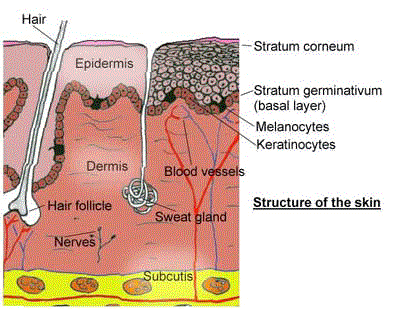 |
The skin (see figure above) is composed of three
layers: -
- Epidermis (epi- meaning on top of) which is
the part that is directly visible,
- Dermis (dermis meaning skin) and
- Subcutis (sub- meaning below and cutis is just
another term for skin).
The epidermis
The epidermis is the uppermost layer of the
skin. It usually measures less than 1mm in thickness and is thickest
on the palms and soles and thinnest on the eyelids. The epidermis
itself is comprised of 5 layers - the top layer of the epidermis
is known as the stratum corneum and the bottom layer is known
as the basal layer. In between these, there are three transitional
layers known as the stratum lucidum, stratum granulosum and stratum
spinosum. The cells of the stratum corneum are dead and composed
primarily of keratin, a hard protein also found in hair, nails,
horns (hence, the alternative term for stratum corneum - horny
layer) and hooves.
Cell division occurs in the basal layer of the
epidermis which is why this layer is also called the stratum
germinativum or germinative layer). This very important part
of the epidermis is composed of two main cell types - the basal
keratinocytes which form nine-tenths and the melanocytes which
form about one-tenth of the total.
The basal keratinocytes are one of the most
actively dividing cells in the body. They produce new keratinocytes
which move upwards pushing the older cells above towards the
surface of the skin. In the next layer, the stratum spinosum,
the cells begin to flatten and as they enter the stratum granulosum,
karatohylin granules accumulate around the nuclei. As the cells
move further up, granules (known as keratohylin granules) accumulate
around the nuclei. These granules are converted into keratin
by an enzyme, the nuclei disappear and the cells die and become
hard (a process known as keratinisation). These dead, hardened
cells make the stratum corneum quite impermeable and this is
why large molecules such as collagen applied to the skin cannot
penetrate and cannot reach the dermis where wrinkles originate.
The stratum corneum layer cells are constantly exposed to and
damaged by the elements and need to be shed and replaced by newer
cells from below. It takes approximately 28 days for the new
cells to reach the surface of the skin and to be shed as scales.
This is known as the cell renewal time. The efficiency of the
cell renewal process (and consequently, skin healing), is dependent
on a good circulation to supply nutrients and oxygen and remove
waste products such as carbon dioxide. If the blood flow is sluggish,
less oxygen and nourishment reaches the epidermis and the cells
of the basal layer do not grow and divide as rapidly as they
should. This may occur as part of ageing and in smokers.
The melanocytes contain an enzyme, tyrosinase
which produce the melanin pigment that protects the body against
the sun's ultraviolet (UV) rays and gives the skin its natural
colour. The melanocytes do not function as efficiently with age
so blotchy pigmentation and age spots (solar lentigines) may
develop.
The condition of the stratum corneum affects
the overall appearance of the skin. The cells on the surface
of the stratum corneum are the oldest and are meant to be shed.
Washing and scrubbing helps to remove these cells, unveiling
the younger healthier cells below.
The amount of moisture in the stratum corneum
is also important. Normally, the stratum corneum cells contain
40% water, 40% keratin and 20% lipids and� a well-hydrated
stratum corneum appears smooth and transparent so that the pinkness
of the dermis underneath shows through. If it is dehydrated,
the cells crumble and the skin takes on a rough, dry and dull
character. Other substances also help the stratum corneum retain
moisture. These include natural moisturising factors (NMFs) produced
by the keratinocytes below and sebum or skin oil produced by
the sebaceous glands. Sebum coats the stratum corneum and prevents
the skin from drying out. Excessive removal of sebum by soaps
or a reduction in the production due to age exacerbates the dryness.
These secretions give the skin a slightly acidic pH of between
5.6 - 6.8.
Also found within the epidermis are Langerhan
cells. These are specialised cells that capture foreign proteins
and present them to the immune system. The Langerhan cells play
a role in protecting the skin against cancers and infection and
are also involved in skin allergies. The number of Langerhan
cells decreases with age and especially with sun-damage and this
may be one reason why skin cancers develop in sun-damaged skin
and and become more common with age.
The Dermis
The dermis is comprised of connective tissue
which itself is comprised of collagen, elastin, reticulin , fibres�
and� ground substance.
Collagen fibres are wavy structures which interlock
with each other, providing firmness (in the same way that the
springs in a mattress do) and also allows the skin to be stretched
without tearing. In the upper part of the dermis known as the
papillary dermis, the collagen fibres are thinner, more loosely
arranged and wavy. In the deeper part of the dermis known as
the reticular dermis, the collagen fibres are thicker, denser
and more horizontal. Damage to the papillary dermis is easier
to repair than damage to the reticular dermis�and this is
why in resurfacing treatments (chemical peels, laser resurfacing
and dermabrasion), the doctor tries not to go too deep and risk
damging the reticular dermis (especially the deeper reticular
dermis).
Elastin fibres are loosely interwoven like a
latticework and can be stretched and yet return to its original
shape and length. They provide elasticity and resilience to the
skin. Reticulin fibres run in between and through the collagen
and elastin fibres and help to support and keep these fibres
in place.
Degeneration of collagen and elastin fibres
with age leads to wrinkling, deep expression lines and sagging.
Ground substance is composed of complexes of
proteins and sugars called mucopolysaccharides. The mucopolysaccharides
provide support for the connective tissue and for the other structures
(about which you will learn shortly) and have extremely good
water-binding abilities.
The dermis also contains hair follicles, sebaceous
(oil) glands, sweat glands, nerve endings, lymphatic vessels
and blood vessels. The hair follicle is an indentation of the
epidermis and contains the same cell layers as the epidermis
except that its base has been modified to form the hair bulb,
a specialised structure that forms hair. Each follicle has a
sebaceous gland attached to it. Sebum (skin oil) produced by
the sebaceous gland flows through a tube into the follicle and
emerges from the same opening or pore as the hair. These pores
may get clogged up, causing acne vulgaris or they may enlarge,
making the skin appear like an orange peel). Excessive sebum
production results in oily, shiny skin while too little oil,
leads to dry, flaky, rough skin with many fine lines.
The sweat glands are coiled structures with
separate, tiny openings that are invisible to the naked eye.
They produce sweat which help to cool the body down through evaporation.
Lymphatic vessels are an important component
of the body's immune system. They carry lymphocytes (a variety
of white blood cells produced in the lymph nodes) throughout
the body and help defend the body against infection and other
foreign invaders.
Blood vessels provide the skin with nutrients
and oxygen and remove waste products such as carbon dioxide.
The blood vessels dilate (open up) when the body is hot so that
more blood flows to the surface of the skin where it can be cooled
and constricts when it is cold so as to reduce blood flow to
the surface and hence, conserve heat.
The nerve endings allow us to feel heat, pressure,
pain, touch and pleasure and keeps the body informed of changes
in the environment and impending dangers.
The subcutis
The subcutis consists of mainly fat.
It acts as a shock absorber, protecting deeper structures, insulates
against heat loss and also acts as an energy reserve. |